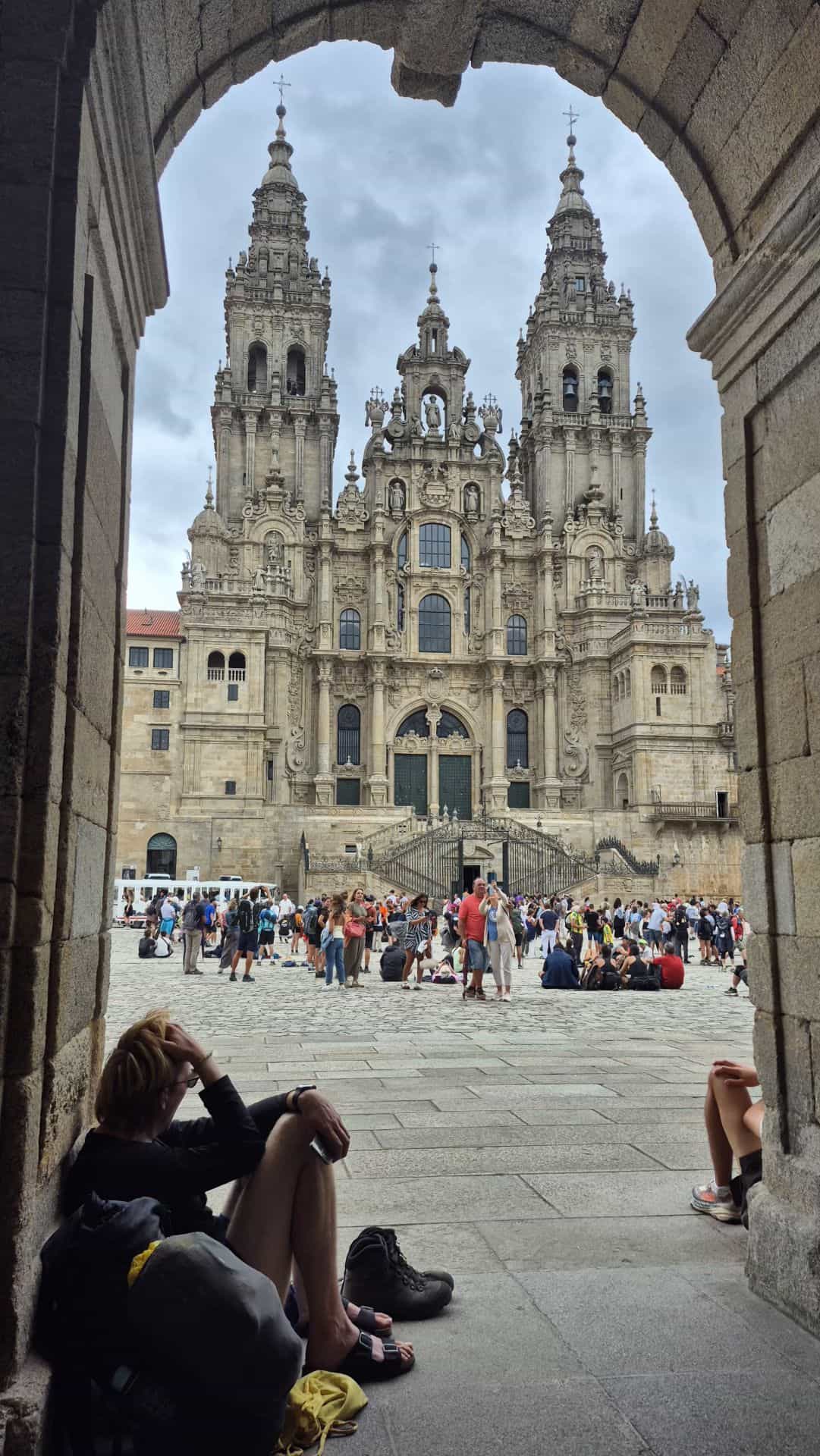
The Camino Pilgrim Passport is your official record of walking the Way of St James. You collect stamps, known as sellos, along your route to prove your distance and claim your Compostela certificate in Santiago.
With U Walk, your Pilgrim Passport is ready for you on arrival, and we handle the practical details of your Camino holiday: hotels with breakfast, luggage transfers, and support when you need it.
At a glance:
- You must collect at least 2 stamps, or sellos, per day during the final 100 km to qualify for your Compostela.
- You can collect stamps in cafés, churches, hotels, tourist offices, monasteries, town halls, and other stops along the Camino.
- We provide your official Pilgrim Passport on arrival, so you are ready to start walking.
- Walkers must complete at least 100 km to Santiago to earn the Compostela. Cyclists must complete 200 km.
- You can also request a Certificate of Distance, which records your route, total kilometres travelled, and arrival date.
Getting Ready for Your Camino
As you begin your Camino, there will no doubt be many thoughts rushing through your mind. Have I packed too much? Or maybe not enough? Will I be able to do this?
Those first few steps are both exhilarating and scary at the same time, and it can be easy for the emotions to take over, but you must start as you mean to go on.
The main thing is to have the right paperwork with you. Apart from your clothes and boots, few items matter more on the Camino than your Pilgrim Passport.
What is the Camino Paperwork?
A huge part of the fun of walking the Camino de Santiago is the sense of freedom that comes with following the little yellow arrows each day. In a busy, stressful world, the Way of St James gives you something simpler: walk, collect your stamp, rest, and repeat.
With that in mind, hearing that you need some paperwork might seem to take away the simplicity of the Camino. But don’t worry, the paperwork is minimal and actually adds a degree of fun along the way.
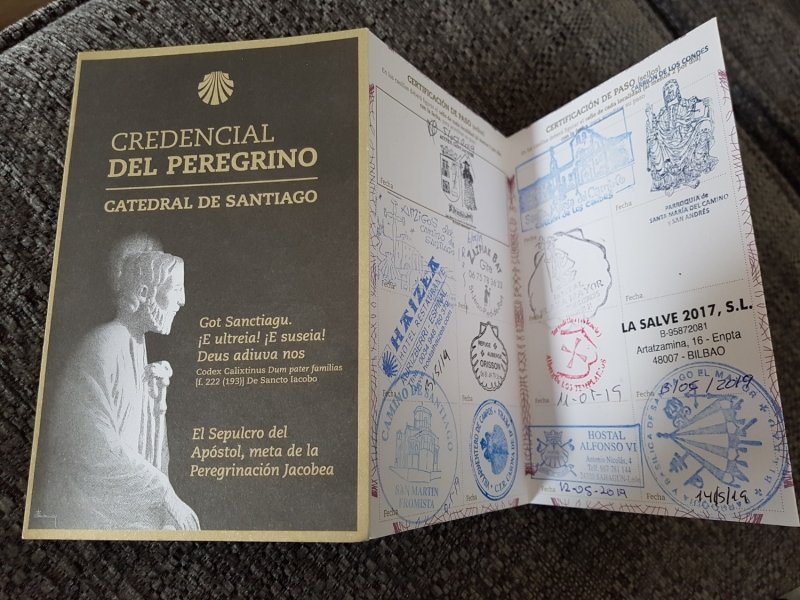
The Camino paperwork is essentially just the ‘Credencial del Peregrino‘ (i.e. Camino Pilgrim Passport or Camino de Santiago Passport or Camino de Santiago stamp book), which is a foldable piece of card with plenty of space on it.

What is the Camino Pilgrim Passport?
The ‘Credencial’ is a series of letters of safe passage that were issued to pilgrims in the Middle Ages. These letters were a sort of insurance for pilgrims, telling thieves and other would-be ‘bad guys’ to leave them in peace.
For more background on this tradition, our guide to the history of the Camino de Santiago explains how the route became one of Europe’s best-known pilgrimage paths.
The Official Credential for the Camino of Santiago includes your personal details, space for the stamp from the organisation that provided the passport, and space for the Cathedral of Santiago stamp when you complete your route.
Keep this document safe. Without it, you will not be able to receive the Compostela, the official document confirming you have met the walking requirements of The Way.
Why Do I Need a Pilgrim’s Passport?
A pilgrim’s passport is important for two reasons:
1. Proof for the Compostela
Your Camino Pilgrim Passport proves you walked the required distance into Santiago. Each stamp shows where you stopped along the route, and the completed passport is checked before your Compostela is issued.
U Walk arranges your hotels with breakfast before you travel, so you do not need to rely on your passport to find a bed each night. Your stamped passport still matters because it proves your walk and becomes a personal record of the places you visited.
2. A Personal Record of Your Camino
Your stamps become a keepsake as well as proof. Many walkers keep their Pilgrim Passport long after they return home because each sello marks a café, church, hotel, town, or quiet stop from their route.
You must walk at least the final 100 km into Santiago to get a Compostela. You cannot claim one earlier if you are not finishing in Santiago.
How do I Get a Pilgrim’s Passport?
If you travel with U Walk, your Pilgrim Passport will be ready for you on arrival. That means you can start collecting stamps straight away, without searching for an office or worrying about opening hours.
Independent walkers can usually get a Pilgrim Passport from pilgrim offices, churches, Camino associations, or authorised organisations at their starting point. Check local opening times before you travel, and make sure the document is the official credential accepted by the Pilgrim’s Office in Santiago.
How Do Camino Stamps Work?
To prove that you have actually walked how far you claim to have walked, you will need to fill out your Camino stamp book. There are very few fraudulent claims these days, and if anything, this is a much-loved practice of old.
You will need to get one stamp per day along the Camino, which goes up to at least 2 stamps per day in the final 100 km. If you’re curious about what your days might look like while collecting these stamps, see a typical day on the Camino to get an inside look at the day-to-day of your upcoming walk!
Where to Get Camino Stamps
Don’t worry, Camino de Santiago sellos (stamps) are everywhere and can be found in bars, restaurants, hotels, post offices, churches, museums, and even the odd food seller by the side of the road. Monasteries and tourist offices are also reliable collection points worth keeping in mind.
This is not something you need to worry about too much. One stamp is usually easy to get where you are staying, and there are plenty of places to collect a second stamp during the day. The aim is simple: show you have walked the distance you are claiming.
Most walkers grow to love stamp collecting. Many sellos have lovely designs, and when you look back at your passport years later, they will bring back the memories.
What Happens if I Lose My Pilgrim Passport?
Losing a pilgrim’s passport certainly adds some hassle, but it is usually fixable. Here is what to do if it happens:
- Stay calm and retrace your steps: Check with cafés, churches, hotels, shops, or other places where you may have left it.
- Contact your current accommodation: Staff may be able to help you check recent stops or advise where to replace it locally.
- Contact U Walk support: If you are travelling with us, our team can help you work through the next practical step.
- Visit a nearby pilgrim office or church: Head to the nearest pilgrim office or church to explain your situation and obtain a replacement passport.
- Carry evidence of your walk: If you’ve been collecting receipts or photos along the way, these can help verify your progress for a new passport.
- Start collecting stamps again: Begin collecting stamps again as soon as you receive your replacement, ensuring you meet the requirements for a Compostela.
Lost passports aren’t exactly a rarity, but you’ll probably be more annoyed with yourself for losing something that will have great sentimental value when you’ve finished.
For more expert advice on tackling challenges along the Camino, see the insights shared by the Chartered Physiotherapist and former Irish International Athlete Siobhan Treacy.
What is the Compostela Certificate?
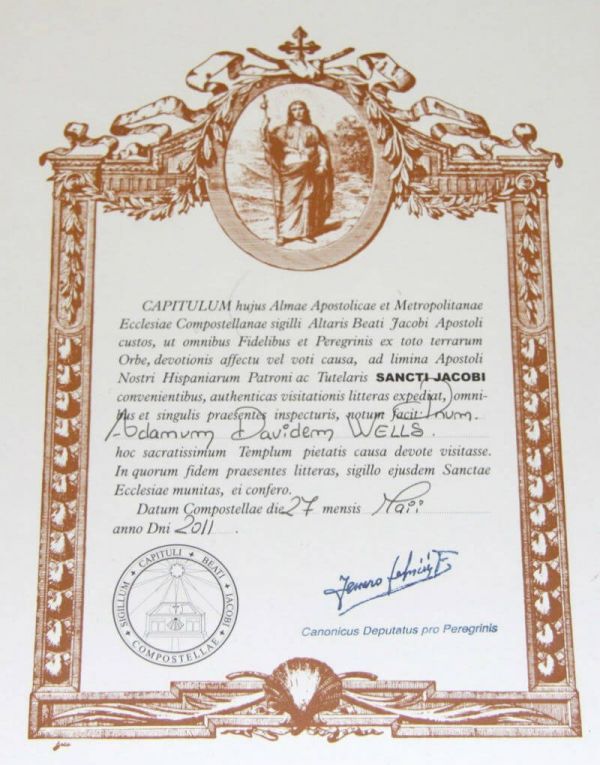
The Compostela Certificate is the official recognition of your Camino pilgrimage, awarded at the Pilgrim’s Office in Santiago. It confirms you have completed at least 100 km on foot, or 200 km by bike, and it is written in Latin to reflect the Cathedral’s long religious tradition.
How do I Get My Compostela?
Once you arrive at the Cathedral of Santiago de Compostela, take your stamped credential to the Oficina del Peregrino, located on Rúa das Carretas, a short walk from the Praza do Obradoiro.
- You’ll need to go to the Pilgrim’s Office in Santiago and first take a number. If there’s nobody around and it’s in the off-season, you might be able to go through immediately, but more often than not, you’ll have some time to wait.
- You can either wait in the office or use the QR code on the ticket to find out your place in real-time and return later. It is recommended that you return when your number is within about 50 places, so you don’t miss your slot.
- This might sound a little complicated, but because of the large number of pilgrims, it’s become necessary to streamline the service as much as possible to prevent huge lines from forming outside.
- When you return, you’ll be asked to present your passport, which will be checked, and then your Compostela will be filled out in front of you. You’ll have to give the information you want on your Compostela to whoever is behind the desk.
The Compostela is tied to the Cathedral’s religious tradition. If you prefer a non-religious certificate, ask about the alternative before the staff member prepares your document.
Several historic Camino routes in Spain, including the Camino Francés and Routes of Northern Spain, are recognised as UNESCO World Heritage Sites. This reflects the long cultural and historical importance of the pilgrimage paths across Spain.
Certificates Beyond Santiago
If you continue beyond Santiago, you may be able to collect additional certificates. The Finisterrana is for walkers who reach Fisterra, and the Muxiana is for those who reach Muxía along the Camino Finisterre route.
U Walk Tips for Your Camino Paperwork
- Keep your passport in a dry, safe place. A careful pocket will not help much if heavy rain soaks through your jacket or bag.
- A waterproof pouch or simply a plastic bag is also a good idea because passports have a habit of falling apart.
- You can also request a Camino Certificate of Distance and a Cathedral Visit Certificate if you wish, both available from the same Pilgrim’s Office. The Certificate of Distance records the total kilometres travelled, your completed route, and your arrival date, and is available in multiple languages for a €3 fee.
- If you are staying in Santiago for a few days, use that time to see the places to visit in Santiago de Compostela before you head home.
- Camino passport stamps are easily found along the Camino, so there’s no need to feel like you necessarily need to go searching for them. Bars, restaurants, shops, and town halls have them, and they are usually advertised somewhere, so you’ll be able to spot them easily.
Walk the Camino with Confidence
Let U Walk take the stress out of your Camino adventure with pre-arranged logistics, expert-guided support, and tailored walking packages.
We are 100% Irish owned, and our team knows how to make the paperwork, planning, and daily walking feel manageable. See our Camino walking tours and step into a seamless, unforgettable experience.